
For the second lecture in our Pluralism Lecture Series we were joined by Dr Steve Keen, author of ‘Debunking Economics’ and ‘Can we avoid another economic crisis?’ Previously a professor at Kingston University, Dr Keen’s efforts are now focused on challenging mainstream economics and highlighting the lack of awareness of disequilibrium in contemporary economics.
The lecture began with an investigation of neoclassical economics with Keen noting that modern neoclassicals are often unaware of their own history. Neoclassical economists generally believe that they’ve proved the existence of ‘The Invisible Hand’ despite the fact that the market provides socially beneficial outcomes in spite of an agent’s intentions. The idea that we actually have no need for markets was then introduced. Put simply; if agents are all knowing, and have rational expectations, then the authority can’t fool the public. It was also noted that historically, whenever neoclassicals have tried to mathematically prove the existence of stability, they’ve actually proved the opposite.
This was initially discovered in relation to Walras’ vision of ‘tatonnement’ leading to multi market equilibrium (something Keen humorously described as groping in the dark). Walras believed that if trade takes place across a range of markets, with each affecting the outcome in another, then every market will eventually converge to equilibrium. However, mathematicians proved the opposite, completely by accident. Applying the ‘Perron-Frobenius Theorem’, it was discovered that either the price or the quantity convergence process would prove unstable.
Through this, Keen surmised that the fundamental flaw in mainstream economics is that most economists believe that capitalism is an equilibrium system. To which he replies, who cares? Citing ‘extremely complicated pseudo-mathematical models’ or “mythematical” frameworks (as he calls them) such as The Invisible Hand (Smith), Rational Expectations (Muth), and the RBC/DSGE models as the reason that economists become bogged down in their own ideas; he argues that we need to accept disequilibrium as the norm. We need a change in the paradigm. This desire to avoid disequilibrium, he believes, is exactly why neoclassical economists didn’t see the crash coming. Where most economists believe that the financial crisis was a Black Swan (of the Taleb variety), Keen categorically disagrees.
The discussion then turned to credit as a component of GDP. Before the crash, it was generally believed that banks acted as intermediaries, receiving deposits from households and lending them back out again. Now, central banks have begun to reject this notion in favour of the idea that banks actually create money and debt. To elaborate on this point he introduced the 3×3 Moore table. A model in which an economy is divided into 3 sectors with each one spending on the other two, where expenditure is recorded on the diagonals and income on the off-diagonals. Each row must sum to zero as someone else’s expenditure is exactly equal to your income. The simplest version of the model holds. However, the introduction of credit quickly shows that the sectors no longer cancel eachother out. This is because credit (an increase in bank liabilities) is created by an increase in debt (bank assets).
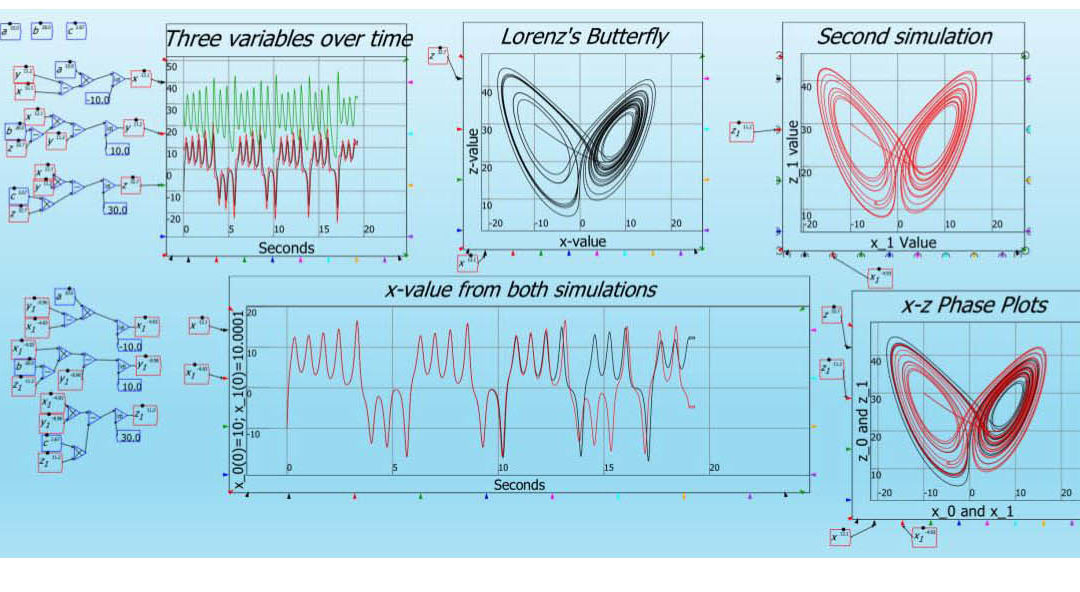
The models and the effects of changing their various inputs were explored using Keen’s Minsky software. The long term implications of a dogmatic pursuit of equilibrium (and the inevitably detrimental impact this has on workers and the wage share of GDP) were demonstrated. Ultimately, Keen concluded that economics needs to ‘grow up’. That bank lending is not just pure redistribution but a creation of money and spending power. And that by ignoring this, economists failed to see the crash coming.
A short Q&A then ensued in which topics such as bureaucracy and regulation in the financial sector, cryptocurrencies, the implications of international trade and the balance of payments, and the imminence of a localised doomsday in developed countries were discussed. The future of microeconomics was also considered, with Keen noting that bad economics (brought on by the insulation of academic economists) equals bad policy. These economists have a tendency to try to change the real world to look like textbooks, rather than the other way around. His solution to this would be to rip up the textbooks, use system dynamics, and collaborate with other disciplines such as mathematics and engineering. Finally, when asked how he sees the Euro playing out in the near future, Keen simply replied: “Badly”.
Those looking for more information on Dr Keen’s work or the development of the Minsky software can find him at